
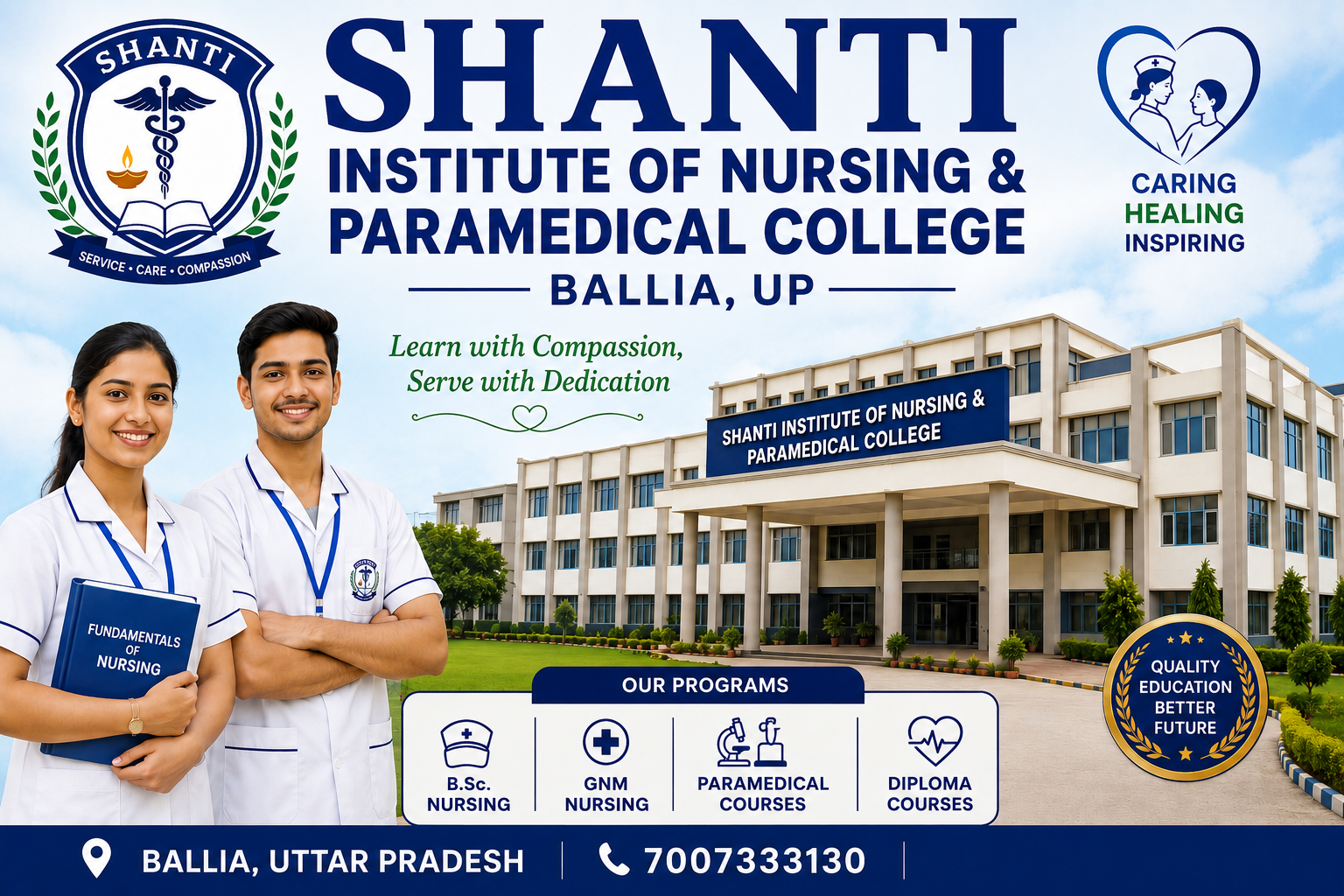
Shanti Institute Of Nursing & Paramedical College, Ballia UP
Healthcare is one of the fastest-growing sectors in India, creating numerous opportunities for students who aspire to build a successful and meaningful career in the medical field. Among the various educational institutions dedicated to healthcare training, Shanti Institute Of Nursing & Paramedical College has emerged as a promising destination for students seeking quality nursing and paramedical education in eastern Uttar Pradesh.
Located in Ballia, the institute focuses on preparing students with professional knowledge, practical skills, ethical values, and clinical expertise required to excel in modern healthcare environments. The institution aims to bridge the gap between academic learning and real-world healthcare services by providing comprehensive nursing and paramedical programs.
About Shanti Nursing College
Shanti Institute of Nursing & Paramedical College is dedicated to nurturing future healthcare professionals who can contribute effectively to hospitals, clinics, community health centers, diagnostic laboratories, rehabilitation centers, and public health organizations.
The institution believes that healthcare education should not only focus on theoretical learning but also emphasize practical training, patient care, communication skills, and professional ethics. Through modern teaching methodologies and clinical exposure, the college strives to produce competent healthcare professionals capable of meeting the evolving demands of the medical sector.
The institute serves students from Ballia, Mau, Ghazipur, Deoria, Azamgarh, Gorakhpur, Varanasi, and neighboring districts, making quality healthcare education accessible to aspiring students across the region.
Vision of the Institute
The vision of Shanti Institute of Nursing & Paramedical College is to become a leading center of excellence in nursing and paramedical education by:
- Providing quality healthcare education.
- Promoting professional competency.
- Encouraging ethical healthcare practices.
- Supporting community health initiatives.
- Developing skilled healthcare professionals.
- Enhancing patient-centered care.
- Contributing to the healthcare workforce of India.
The institution seeks to empower students with knowledge, confidence, and practical expertise that enable them to serve society effectively.
Mission of the Institute
The mission of the institute includes:
1. Academic Excellence
Delivering high-quality education through innovative teaching methods and updated curricula.
2. Clinical Competence
Providing extensive practical exposure and clinical training in healthcare settings.
3. Professional Development
Helping students develop leadership qualities, communication skills, and professional ethics.
4. Community Service
Encouraging participation in health awareness programs and community healthcare initiatives.
5. Lifelong Learning
Promoting continuous professional growth and advanced education opportunities.
Importance of Nursing Education
Nursing is one of the most respected professions worldwide. Nurses form the backbone of healthcare systems and play a crucial role in patient care.
The demand for qualified nurses continues to grow due to:
- Expansion of healthcare facilities.
- Rising population.
- Increased awareness of healthcare services.
- Growth of medical tourism.
- Government healthcare initiatives.
- Aging population requiring long-term care.
Nursing professionals are responsible for:
- Patient assessment.
- Medication administration.
- Health education.
- Disease prevention.
- Emergency care.
- Rehabilitation support.
- Community healthcare services.
The Shanti Institute of Nursing & Paramedical College focuses on preparing students to meet these responsibilities with confidence and competence.
Importance of Paramedical Education
Paramedical professionals are essential members of healthcare teams. They support doctors, nurses, and specialists in diagnosis, treatment, and patient management.
Paramedical fields include:
- Medical Laboratory Technology.
- Radiology.
- Operation theater technology.
- Emergency Medical Services.
- Physiotherapy Assistance.
- Dialysis Technology.
- Critical Care Technology.
As healthcare facilities become more advanced, the need for trained paramedical personnel continues to increase.
The institute aims to provide practical-oriented education that prepares students for immediate employment opportunities in healthcare settings.
Academic Programs
The institute offers various nursing and paramedical programs designed to meet industry requirements.
ANM (Auxiliary Nurse Midwife)
ANM is one of the most popular nursing courses for students interested in community healthcare and maternal-child health services.
Course Highlights
- Focus on primary healthcare.
- Maternal and child health.
- Community health nursing.
- Health education.
- First aid and emergency care.
Career Opportunities
ANM graduates can work in:
- Primary Health Centers.
- Community Health Centers.
- Government healthcare programs.
- NGOs.
- Rural healthcare projects.
GNM (General Nursing and Midwifery)
GNM is a comprehensive nursing diploma program that prepares students for clinical and community healthcare roles.
Key Subjects
- Anatomy and Physiology.
- Medical-Surgical Nursing.
- Pediatric Nursing.
- Psychiatric Nursing.
- Community Health Nursing.
- Midwifery.
Career Scope
GNM graduates can work as:
- Staff Nurses.
- Ward Nurses.
- Community Health Nurses.
- Home Care Nurses.
- Nursing Supervisors.
B.Sc. Nursing
B.Sc. Nursing is a professional undergraduate degree program that offers advanced nursing education.
Curriculum
- Nursing Foundations.
- Medical-Surgical Nursing.
- Child Health Nursing.
- Mental Health Nursing.
- Community Health Nursing.
- Nursing Research.
- Nursing Management.
Benefits
- Better career opportunities.
- Higher salary prospects.
- Eligibility for postgraduate education.
- Opportunities in India and abroad.
Modern Infrastructure
A strong educational environment requires modern infrastructure and learning facilities.
The institute focuses on providing:
Smart Classrooms
Well-equipped classrooms facilitate interactive learning through:
- Audio-visual teaching.
- Presentations.
- Digital learning resources.
- Group discussions.
Nursing Laboratories
Practical training begins in skill laboratories where students learn procedures before clinical exposure.
Laboratories include:
- Fundamentals of Nursing Lab.
- Community Health Nursing Lab.
- Obstetrics and Gynecology Lab.
- Pediatric Nursing Lab.
Students practice:
- Injection techniques.
- Dressing procedures.
- Patient assessment.
- Emergency response skills.
Paramedical Laboratories
Advanced laboratory facilities help students gain hands-on experience in:
- Diagnostic procedures.
- Laboratory investigations.
- Equipment handling.
- Sample analysis.
Library
The college library supports academic growth through:
- Nursing textbooks.
- Medical journals.
- Reference books.
- Research publications.
- Digital resources.
Students can access updated learning materials for examinations and professional development.
Computer Laboratory
Digital literacy is essential in modern healthcare.
Computer labs help students learn:
- Medical documentation.
- Healthcare software.
- Online research.
- Digital communication.
Experienced Faculty
Faculty members play a crucial role in shaping healthcare professionals.
The institute focuses on recruiting qualified and experienced educators who provide the following:
- Classroom teaching.
- Practical demonstrations.
- Clinical guidance.
- Research support.
- Career counseling.
Faculty members encourage students to develop critical thinking, problem-solving skills, and professional confidence.
Clinical Training and Practical Exposure
Practical experience is the foundation of nursing and paramedical education.
Students receive clinical exposure in healthcare settings where they learn the following:
- Patient care techniques.
- Hospital procedures.
- Medical documentation.
- Emergency response.
- Infection control practices.
Clinical training helps students apply theoretical concepts in real-life situations.
Community Health Programs
Healthcare education extends beyond hospitals.
The institute encourages participation in:
- Health awareness campaigns.
- Immunization drives.
- Nutrition programs.
- Women’s health initiatives.
- Rural healthcare camps.
These activities help students understand public health challenges and develop social responsibility.
Personality Development
Healthcare professionals require strong interpersonal skills.
The institute supports personality development through:
- Communication training.
- Leadership programs.
- Group activities.
- Public speaking sessions.
- Professional ethics workshops.
These skills help students perform effectively in healthcare environments.
Importance of Practical Learning
Practical learning improves:
- Clinical confidence.
- Technical competence.
- Decision-making ability.
- Patient interaction skills.
The institute emphasizes experiential learning through:
- Demonstrations.
- Simulation exercises.
- Clinical postings.
- Case studies.
Career Opportunities After Nursing and Paramedical Courses
Healthcare education opens doors to diverse career paths.
Government Sector
Graduates may pursue opportunities in:
- Government hospitals.
- Health departments.
- Public health programs.
- Community healthcare centers.
Private Hospitals
Private healthcare institutions require skilled professionals in:
- General wards.
- Intensive Care Units.
- Emergency departments.
- Operation theaters.
Diagnostic Centers
Paramedical professionals can work in:
- Pathology laboratories.
- Imaging centers.
- Diagnostic clinics.
Educational Institutions
Experienced professionals may enter:
- Teaching.
- Clinical instruction.
- Academic administration.
International Opportunities
Qualified nursing professionals are in demand across various countries due to global healthcare workforce shortages.
Why Choose Shanti Nursing College?
Students choose the institute because of:
Quality Education
Focus on academic excellence and practical learning.
Skilled Faculty
Guidance from experienced healthcare educators.
Clinical Exposure
Real-world healthcare experience.
Student Support
Mentorship and academic assistance.
Career-Oriented Programs
Courses designed according to healthcare industry requirements.
Affordable Education
Accessible healthcare education for students from various backgrounds.
Student Life
A vibrant educational environment contributes to holistic development.
Students participate in:
- Cultural events.
- Health awareness activities.
- Educational seminars.
- Sports competitions.
- Community outreach programs.
These activities enhance confidence, teamwork, and leadership skills.
Role of Nurses in Modern Healthcare
Nurses are healthcare leaders who contribute to the following:
- Patient safety.
- Health promotion.
- Disease prevention.
- Family education.
- Community development.
Their role continues to expand with advancements in healthcare technology and patient-centered care.
Future of Nursing and Paramedical Education
India’s healthcare sector is experiencing rapid growth.
Factors driving demand include:
- Expansion of hospitals.
- Government healthcare schemes.
- Medical technology advancements.
- Increased health awareness.
- Growing healthcare investments.
As a result, trained nursing and paramedical professionals will remain highly sought after in the coming decades.
Frequently Asked Questions (FAQs)
1. Where is Shanti Institute of Nursing & Paramedical College located?
The institute is located in Ballia, Uttar Pradesh.
2. Which nursing courses are available at the institute?
The institute offers ANM, GNM, and B.Sc. Nursing programs (subject to current approvals and availability).
3. What is the duration of the ANM course?
ANM is generally a two-year nursing program, depending on regulatory guidelines.
4. What is the duration of the GNM course?
GNM typically spans three years along with internship requirements as per regulations.
5. What is the duration of a B.Sc. in Nursing?
A B.Sc. in Nursing is generally a four-year undergraduate degree program.
6. Is practical training included in the courses?
Yes, practical and clinical training are important components of nursing and paramedical education.
7. What career opportunities are available after GNM?
Graduates can work as staff nurses, community health nurses, and healthcare professionals in various medical institutions.
8. Can ANM graduates work in government healthcare programs?
Yes, ANM graduates may be eligible for opportunities in government and community healthcare programs according to recruitment criteria.
9. Does the institute focus on community healthcare?
Yes, community health education and outreach activities are important aspects of healthcare training.
10. Are laboratory facilities available for students?
Yes, nursing and paramedical laboratories support practical skill development.
11. Why is nursing considered a good career option?
Nursing offers job stability, career growth, global opportunities, and the chance to serve society.
12. What skills are developed during nursing education?
Students develop clinical skills, communication abilities, leadership qualities, and patient-care competencies.
13. Are paramedical courses in demand?
Yes, the healthcare industry has a growing demand for skilled paramedical professionals.
14. Can students pursue higher education after nursing programs?
Yes, graduates can pursue advanced nursing and healthcare education according to eligibility requirements.
15. Why should students choose Shanti Institute of Nursing & Paramedical College?
The institute focuses on quality education, practical training, professional development, and career-oriented healthcare programs.
Thanks and Regards
For Counseling and Admission Guidance:
[7OO733313O – 7O81O2O3O4]
Sorry, the comment form is closed at this time.